Friday, January 15, 2010

Nina Katchadourian's Natural Car Alarms


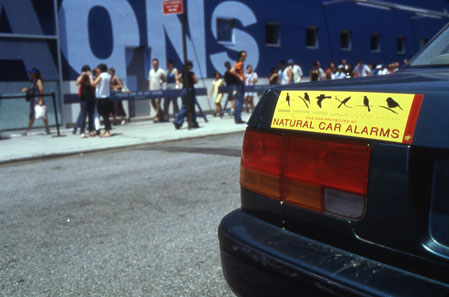
[From www.ninakatchadourian.com] 'Natural Car Alarms is a project consisting of three cars rigged with modified car alarms whose typical six-tone siren has been replaced with a similar one made only of bird calls. Some of the bird sounds are shockingly electronic in character; others are very bird-like in the quality of their sound, but very alarm-like in their patterning.' Hear an excerpt here:
www.npr.org/programs/atc/features/2002/july/car_alarm/

Shark safe sticker


While walking around SOMA last Sat, I saw this sticker at the entrance to a Chinese restaurant (Fang). Needless to say this restaurant is now the one to take parents and relatives.

Animal Welfare Approved, Certified Humane, Organic certification

Update 04.21.2011: A better certification than both 'Certified Humane' and 'Organic' is 'Animal Welfare Approved'. For example, while both 'Certified Humane' and 'Organic' allow debeaking of chickens and forced molting through starvation to maximize egg production, 'Animal Welfare Approved' doesn't. Here's a chart comparing the different certifications for eggs: www.grist.org/phpThumb/phpThumb.php?src=http://www.grist.org/i/assets/humane_eggs.jpg&w=615. Here's another one which addresses forced molting: www.humanesociety.org/issues/confinement_farm/facts/guide_egg_labels.html. Comparison charts for all animals: www.eathumane.org/pages/2500_comparing_food_labeling_programs.cfm

To find places in your area which are Animal Welfare Approved, just type in your zip code on this page: www.animalwelfareapproved.org/product-search

Previous 01.15.2010: The Certified Humane Raised & Handled® program is a farm animal welfare and food labeling program in the U.S. dedicated to improving the welfare of farm animals in food production and include all stages of the animal's life including handling and slaughter. Humane Farm Animal Care's Animal Care Standards require that animals have ample space, shelter and gentle handling to limit stress. Here’s a list of products that are certified humane products. In San Francisco, there are many stores that carry certified humane products: Prather Ranch Meat Company (at the Ferry Building), Andronico’s, Bi-Rite, Buffalo Whole Foods, Good Life Grocery, Harvest Ranch Market, Mollie Stone’s, Nature’s Stop, Other Avenues, Rainbow Grocery, Real Foods, Tower Market, Valencia Natural Foods, and Whole Foods. Most of them have only dairy, none have eggs, a few have meat and deli items. Delica (in the Ferry Building) gets some of its meat from Prather Ranch. Incanto is a certified humane restaurant in San Francisco.

Related:
Temple Grandin (2010) is a biopic of Temple Grandin (played by Claire Danes), an autistic woman who became one of the top scientists in humane farm animal handling.

Favorite vegan dishes in San Francisco —
Hijiki-soybean salad at Delica (vegetarian-friendly)
Papaya salad at Out the Door (vegetarian-friendly)
Bean curd rolls, bittermelon-tomato, 'seabass'-eggplant at Enjoy (vegetarian)
Anything at Millenium (vegan)

Marlene McCarty's Group 3


Image: www.sikkemajenkinsco.com

'Humans nurse baby apes, and humans and gorillas communicate in sign language. ... drawings are visible underneath the final version, suggesting that each narrative has a potential for multiple interpretations. You may discover an outline of a gorilla behind the figure of a man, a faint moustache on a woman's face and many hermaphroditic figures.'
[www.bloomberg.com/apps/news?pid=20601088&sid=aPrH0Y.UbfBk&refer=muse]

Interspecies communication: Koko, a talking gorilla


Video: www.youtube.com/watch?v=Pmuu8UEi2ko&feature=video_response

Related:
Chimp gets peanut out of tube
Chimp is better than humans at game
Nature: Koko. PBS, 2004.
Koko: A Talking Gorilla directed by Barbet Schroeder. Criterion, 1978. (On youtube.)
Our Inner Ape by Franz de Waal. Riverhead, 2005.
Primate Visions: Gender, Race, and Nature in the World of Modern Science by Donna Haraway. Routlege, reprinted 1990.

Saturday, January 9, 2010

Diana Thater's gorillagorillagorilla


Video: www.nhm.ac.uk/visit-us/whats-on/expressions/expressions-slideshow/thater-video-clip/index.html

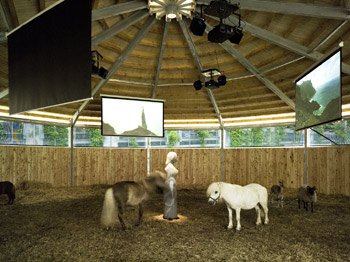
Diana Thater created a touching piece, a video installation 'gorillagorillagorilla'. '[It] is placed opposite a diagonal that cuts across the Jerwood Gallery. Thater’s silent moving image installation intervenes in and deconstructs the existing nineteenth century terracotta architecture. The viewer becomes part of the work, her or his shadow disturbing and contributing to the scaled narrative of the gorillas filmed in the rainforest of the Mefou Sanctuary in Cameroon. The installation creates a recurrent experience, allowing the spectator to revisit the moving imagery as he or she weaves in and out of the individual rooms. In Thater’s work, nature becomes larger and wider than we can fathom. "I create sculptures with images of nature in space,’ says Diana Thater, describing her monumental video installations that analyse complexities of the natural world, and their relationship with the human being."' This work was a co-commission by the London Natural History Museum and Kunsthaus Graz and was created with the support of Bristol Zo Gardens and the Mefou Sanctuary in Cameroon.
[www.gulbenkian.org.uk/news/press-releases/2009/after-darwin]

Becoming Animal: Patricia Piccinini, Motohiko Odani


Image: Patricia Piccinini's life-like sculpture


Images: Video stills from Motohiko Odani's Rompers

'In Becoming Animal, 12 internationally known artists investigate the shifting boundaries between animal and human. ... The works included in Becoming Animal—which accompanies an exhibit at MASS MoCA—range from the aviary and cabinet of curiosities of Mark Dion to the gun-toting bird collages of Michael Oatman. Nicolas Lampert's machine-animal collages and Jane Alexander's corpse-like humanoids suggest a new landscape of alienation. Rachel Berwick's investigation of the last Galapagos tortoise from the island of Pinto and Brian Conley's humanized mating call of the Tungara frog question the divide between human and animal communication. Patricia Piccinini imagines a bodyguard for a bird on the edge of extinction and Ann-Sofi Siden recreates the bedroom—and paranoia—of psychologist Alice Fabian. Natalie Jeremijenko presents another installment in her ongoing Ooz, reverse-engineering the zoo, and Kathy High's installation of "trans-animals" remembers lab rats who have given their lives for science. Sam Easterson's videos allow us to see from the viewpoint of an aardvark, a tarantula, a tumbleweed; Motohiko Odani's films show a surrealistic genetically modified bestiary. Becoming Animal documents these works with eye-popping full-color images, taking us on a visual journey through an unknown world.'

Nato Thompson, editor. Becoming Animal (catalog to Mass MOCA exhibit). Cambridge: MIT Press, 2005. <mitpress.mit.edu/catalog/item/default.asp?ttype=2&tid=10590>

Friday, January 8, 2010

Mark Menjivar's fridge photos


Above: The refrigerator of a midwife and middle-school science teacher from San Antonio, shot the week after deciding to eat locally grown produce. Below: the refrigerator of a San Antonio bartender.

[From Mark Menjivar's statement] 'You Are What You Eat is a series of portraits made by examining the interiors of refrigerators in homes across the United States. For three years I traveled around the country exploring food issues. ... Each fridge is photographed "as is." Nothing added, nothing taken away. These are portraits of the rich and the poor. Vegetarians, Republicans, members of the NRA, those left out, the under appreciated, former soldiers in Hitler’s SS, dreamers, ... My hope is that we will think deeply about how we care. How we care for our bodies. How we care for others. And how we care for the land.' [Via Eyeteeth blog]

Related:

It's important for women who are vegan/vegetarian/pescetarian to get enough iron. Iron is the backbone nutrient for enhancing the building of oxygenated blood. Vitamin B12 is also needed to make healthy blood. Iron is a key nutrient in cells that enables thyroid/zinc gene signals to function in metabolic pathways. Non-heme iron can be hard to absorb. Eat iron-rich food (e.g. pumpkin seeds — raw pepitas from Trader Joe's) and iron supplements together with food that enhance the absorption of iron (vitamin C-rich food, brocolli). Foods that inhibit the absorption of iron include coffee and spinach.

Iron Rich Foods containing Non-Heme Iron

Beans (lentils are a great source)
Pumpkin seeds
Blackstrap molasses
Baked potato with skin
Canned asparagus

Iron Absorption Enhancers

Fruits: orange, orange juice, cantaloupe, strawberries, grapefruit etc
Vegetables: broccoli, brussels sprouts, tomato, tomato juice, potato, green & red peppers
White wine

Iron Absorption Inhibitors
Red wine, coffee & tea
Vegetables: spinach, chard, beet greens, rhubarb and sweet potato
Whole grains and bran
Soy products
[www.healthcastle.com]

Other good iron sources include kelp (algae and spirulina, chlorella, dulse, sea lettuce) and red beet root.

Carol J. Adams's 'An Animal Manifesto'


Excerpts from an interview with Carol J. Adams by Tom Tyler, "An Animal Manifesto: Gender, Identity, and Vegan-Feminism in the Twenty-First Century", on topics such as Haraway's companion animals, and the question of animals rights in a postmodern age:

'TT: Donna Haraway has, of course, written two manifestos already: for cyborgs and for companion animals. I know you have reservations about the latter: what are its limitations from the perspective of a vegan-feminist manifesto?

CJA: I think she is attempting something more profoundly personal here. But I found the final product, her small pamphlet, extremely disturbing. It feels uneven, as though it were cobbled together. And her voice is not so much ambiguous as inconsistent. Sometimes it feels downright petulant. It’s the lacunae in Haraway that disturb. Reading it against and with Derrida make what is left unsaid so damning. Derrida’s feels to be a manifesto in all but name; Haraway’s a manifesto only in name, more an apologia. Discussing circuses, Derrida paints a picture of ‘an animal trainer having his sad subjects, bent low, file past.’ Haraway, through a reference to Vicki Hearne’s beliefs, defends ‘circus trainers,’ referring to animals in the circus as ‘the animals they work with’. At this point, with all the information about circuses, why would someone alert to how words work, choose the euphemism ‘work with’? Derrida, as you point out, does not shy away from engaging the issue of the Holocaust and genocide when talking about what is happening to animals, while Haraway pauses to condemn ‘the outrageous equating of the killing of the Jews in Nazi Germany, the Holocaust, with the butcheries of the animal-industrial complex’.

Regarding animal rights, Haraway is dismissive, calling us the ‘rights besotted’. Derrida, more generously, acknowledges ‘In response to the irresistible but unacknowledged unleashing and the organized disavowal of this torture, voices are raised – minority, weak, marginal voices, little assured of their discourse, of their right to discourse and the enchantment of their discourse within the law, as a declaration of rights – in order to protect, in order to appeal (we’ll return to this) to what is still presented in such a problematic way as animal rights, in order to awaken us to our responsibilities and our obligations with respect to the living in general, and precisely to this fundamental compassion that, were we to take it seriously, would have to change even the very basis (and the basis is what I wish to discuss today) of the philosophical problematic of the animal’.

Haraway’s embrace of Vicki Hearne’s position, a position left fixed by her death, results in an impatient, and I would argue, dated, dismissal of ‘animal rights’. Haraway’s aversion to animal rights doesn’t seem to have mutated or adapted since Hearne’s 1991 article against animal rights. I wish I could understand the categorical disparagement of animal rights that, with a broad sweep, includes even those animal advocates who challenge ‘rights language’, a large majority of whom are women. For which companion species can we safely advocate if we wish to avoid her derision? Only dogs? I do not comprehend why a feminist concerned with relations between species decidedly ignores the many feminist scholars who have been writing and talking about this issue, some for at least twenty years. Haraway is interested in finding the ‘relational model of training’, making her disinterestedness in a relational model for veganism and other relationships with animals more shocking. Derrida says ‘no one can deny the unprecedented proportions of this subjection of the animal […] No one can deny seriously, or for very long, that men do all they can in order to dissimulate this cruelty or to hide it from themselves, in order to organize on a global scale the forgetting or misunderstanding of this violence that some would compare to the worst cases of genocide (there are also animal genocides: the number of species endangered because of man takes one’s breath away)’. Yet Haraway seems to.

And what of dogs? She is interested in ‘naturecultures’ - the naturecultures of humans and canines, for instance, and ‘ethical relating, within or between species’. She condemns ‘impulse buyers’ of special breeds of dogs who then dump their dogs, but the breeders for whom the ‘whole dog’ is both a kind and an individual (perhaps the beginning of the problem), and who continue to produce these ‘purebreds,’ escape her critique in this part of the manifesto. Where do the impulse buyers get their dogs?

Can a manifesto compromise? Shouldn’t a manifesto leap to the place where compromise, or half responses, are seen as what they are, a bargain with the established order against which your manifesto is standing? Like a manifesto for companion animals that uses purebreds as the referents? Why breed animals? Why claim for history more value than contemporary situations?

While Haraway acknowledges the ‘scandal of the meat-producing “animal industrial complex”’, she only finds historical irony in the introduction of ‘Basque Pyrenean mountain dogs, who were nurtured in the purebred dog fancy, onto the ranches of the US west to protect Anglo ranchers’ xenobiological cattle and sheep’. Surely there is more than irony here. She seems so hesitant to address herself to the species with whom humans have the least ethical relation - the animals that people eat - indeed, referring to a stop at Burger King to get ‘burgers, coke, and fries’. Her book was published after Burger King started selling veggie burgers, but she fails to tell us what sort of burger she bought.

Haraway protects the dominance that ontologises animals as edible just as the sheepdogs she celebrates protect the ontologised ‘livestock’. She renders unto the renderers the bodies of animals. ‘Livestock’ become the untouchable natureculture intersection and not because of the prions from rendered ‘mad’ cows that cannot be destroyed, but because she cannot or will not acknowledge the possibility that livestock might also be companion species.

I know Haraway is not alone in viewing ‘animal rights’ discourse as proscriptive and ideological, that some people believe a certain possibility of becoming is denied when one tells another what not to do, that we deprive another when we speak or make demands, that activists are dictating to others. But in any evolving natureculture, we should stipulate that flesh eating, unlike debates about it, involves more than human beings. Humans consume animal beings. In human-oriented arguments, the fact that others are dictating to animals by eating them disappears. If we agree to one of the points I propose in the vegan-feminist manifesto, that at least three beings are involved in a discourse about flesh eating (the speaker, the hearer and the animal being eaten), then we see that there is an a priori deprivation within these critiques that needs to be acknowledged: the death of the animal.
...

TT: Your most recent paper, ‘Post-meateating’, considers animal rights as a modern movement in a postmodern age.

CJA: This may offer another explanation for the dismissal of animal rights discourses. In The Sexual Politics of Meat, I proposed that nonhumans used for meat were absent referents. In ‘Post-meateating’ I explore the implications of Frederic Jameson’s insight that in general we have passed from the modern period with nature still a referent, to a postmodern period with culture as the referent. His insight suggests that in a postmodern time the animals have been loosed completely from their status as absent referent — instead the referent will have a cultural context only.

When postmodernism supplanted the idea of the individual, autonomous subject with the idea of multiple selves and a fluid subject, Tom Regan’s scholarly attempt to claim consciousness and biography for animals, The Case for Animal Rights,27 seemed to lose its relevance. (But why not attribute such multiple selves to other animals too?) The animal rights movement that traces itself to Regan or Peter Singer has the misfortune of articulating a modernist claim just as postmodernism absorbs and displaces modernist thinking. It appears dated, announcing in its activism (boycotts/placards/lobbying) its own supposed anachronism. It appears absolutist and serious in a time when irony and self-deprecation prevail. It is seen as too literal, too preachy. Trying to get culture to get back to the referent ‘animal’ is seen as too boring, not playful.

This appears to be what People for the Ethical Treatment of Animals (PETA) knows. They often deploy visual images but with cultural referents. They use supermodels. They use actors. They take any cultural idea that is circulating and appropriate it. Rather than producing for general consumption the ‘bleeding Jesus’ pictures, as one Catholic friend calls them, of damaged, injured animals, PETA puts on Mickey Mouse masks to protest animal experimentation. They’re ironic.

PETA seems to acknowledge that for many people the referent, animals, is gone. And they are trying to work with what is there, cultural consumption, by manipulating cultural images/issues. They are trying to get people to talk about veganism without having to address what has disappeared. It doesn’t matter who they piss off. In fact the more the better. Tastelessness is newsworthy; nonhuman farmed animals aren’t. The strongest reminder for me of this is that people continue to eat ‘beef’ after the news about mad cows.

One of the results when the cultural becomes the referent, is not only that we forget we are animal beings, but we are allowed to forget that other animals are animal beings, too! Karen Davis says the human hand is the cruelest thing a chicken will know. The non-ambivalent action the activist wants is to stop that hand.I think I still cling to words like ‘integrity’. What sort of referents are animals in scholarly discourse? Are they allowed to be embodied animal beings?'

[References at <www.caroljadams.com/text_interview7.html>. First published in Parallax 38 (Jan-Mar 2006), p120-28. ]

Related books by Carol J. Adams:
The Sexual Politics of Meat: A Feminist-Vegetarian Critical Theory.
The Feminist Care Tradition in Animal Ethics: A Reader, edited with Josephine Donovan. Columbia University Press.
Living Among Meat Eaters: The Vegetarian’s Survival Handbook. Continuum, 2003. Chinese edition, 2005
How to Eat Like a Vegetarian More than 250 Shortcuts, Strategies, and Simple Solutions, Carol J. Adams, Patti Breitman
The Pornography of Meat. New York: Continuum International, 2003.
Ecofeminism and the Sacred, editor. New York: Continuum International, 1993.
Neither Man nor Beast: Feminism and the Defense of Animals. New York: Continuum International. 1994. (Pictured above)
Animals and Women: Feminist Theoretical Explorations, an anthology edited with Josephine Donovan. Durham, NC: Duke University Press, 1995.

More resources


Carol J. Adams. The Sexual Politics of Meat. London: Continuum International Publishing Group, 1999.
Steve Baker. Postmodern Animal. Chicago: University of Chicago Press, 2000.
Nigel Rothfels, editor. Representing Animals. Bloomington: Indiana University Press, 2002.
Jacques Derrida. The Animal That Therefore I Am. Fordham University Press, 2008.
Donna Haraway. Companion Species Manifesto. Chicago: University of Chicago Press, 2003.
Cary Wolfe. Zoontologies: The Question Of The Animal. University Of Minnesota Press, 2003.
Lorraine Daston, editor. Thinking with Animals: New Perspectives on Anthropomorphism. Columbia University Press, 2006.
Matthew Calarco. Zoographies: The Question of the Animal from Heidegger to Derrida. Columbia University Press, 2008.
Mark Dion and Alexis Rockman, editors. Concrete Jungle. New York: Juno Books, 1997.
Meredith Tromble. "We Are/Are Not Animal". <www.stretcher.org>
Gene(sis) show at BAM <www.bampfa.berkeley.edu/exhibition/genesis>

Mircea Cantor’s Deeparture


Image: still from video

Another piece which would add to the show. 'Cantor’s nearly three-hour Deeparture (2005) is as severely economical in its setup as it is intense in its poetic potential. It involves two unwitting players, a wolf and a deer, in perhaps the most unlikely and artificial environment in which they can find themselves—a white-cube gallery. The artist shot the animals in 16mm film with a seemingly unforgiving eye, structuring a series of taut close-ups from various angles into a seamlessly looping video. Confounding expectations, the “natural” predator-prey relationship does not play itself out here. Instead, both animals keep their distance from each other and appear in turn tense, confused, exhausted, and dejected, even oblivious. As viewers are gradually roped into emotional engagement with the ultimately unreadable animals, they’re led to wonder if these nonhuman players serve as a blank screen upon which human emotions and psychological attachments are projected.' [visualarts.walkerart.org/detail.wac?id=3552&title=Acquisitions]

Interspecies collaboration: William Wegman, Catherine Chalmers


Video: www.youtube.com/watch?v=j6afbl--ze8

These two works are not in the show but could enhance it. The first (functioning ironically) is Dog Biscuit in Glass Jar of William Wegman's puppy trying to extract a biscuit from a glass bottle. People who like dogs may be uncomfortable watching this video.


Video: www.catherinechalmers.com/videos.cfm?view_photo=3

The second is Burning at the Stake by Catherine Chalmers (who has a different piece in the show). Even though nobody likes cockroaches, this is surprisingly not easy to watch. If you like this piece you may like Safari which is another video by Chalmers. Below is a list of resources from the show's website.

EXHIBITIONS RELATED TO INTERSPECIES ART

Intelligent Design: Interspecies Art <sweeney.ucr.edu>
After Darwin <www.nhm.ac.uk/visit-us/whats-on/expressions/expressions-exhibition/index.html>
Animalkind <artgallery.sdsu.edu/exhibitions/2009_animalkind/>
Becoming Animal <www.massmoca.org/event_details.php?id=310>
Hybridity: The Evolution of Species and Spaces in 21st-Century Art <www.21cmuseum.org/museum/exhibits/hybridity.aspx>
Interspecies <www.artscatalyst.org/projects/global/interspecies.html>

BOOKS

Steve Baker. Picturing the Beast: Animals, Identity and Representation. Manchester: Manchester University Press, 1993.
John Berger. "Why Look at Animals" in About Looking. NY: Pantheon Books, 1980.
Donna Haraway. When Species Meet. Minneapolis: University of Minnesota Press, 2008.
J.M. Coetzee. The Lives of Animals. New Jersey: Princeton University Press, 1999.
Linda and Amy Fitzgerald Kalof, editors. The Animals Reader. Oxford and New York: Berg Press, 2007.

OTHERS

The Animal Gaze <www.animalgaze.org/>
Eco-Centric Topics <avant-guardians.com/ecocentric.html>
Green Museum <greenmuseum.org/>
Interspecies <www.greenpeople.org/webpage.cfm?memid=1703&pmtlevel=0&linkpage=http://www.interspecies.com>
Interspecies Collaboration <www.interspeciescollaboration.net/>

Catherine Chalmer's Safari


Video: www.catherinechalmers.com/videos.cfm

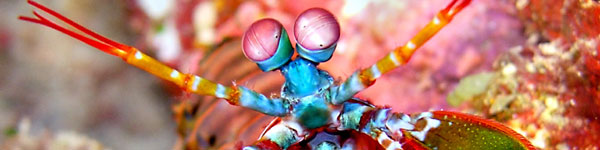
[From UCR Sweeney] 'A macroscopic lens follows the point of view of a cockroach on adventures in an apparent tropical paradise, encountering exotic insects that Chalmers collected for the film.' Below is a photo of a shrimp Peacock Mantis Shrimp (detail) by Joseph Napolitano.

Saturday, January 2, 2010

Interspecies art: Nina Katchadourian's Continuum of Cute


Image: aluminum shelf, 100 individual aluminum mounted photographs, 200 inches

[From UCR Sweeney] 'Fascinated by a profusion of cute animal pictures found on the web, Nina Katchadourian collected one hundred passport-sized photos and arranged them in order of cuteness for Continuum of Cute. This "interspecies beauty contest" - though highly subjective - might have consequences for an animal's ultimate survival.'

Interspecies art: Jill Greenberg's Monkey Suit


Image: archival pigment print, 50x42 in.

I just saw the show Intelligent Design: Interspecies Art at UCR Sweeney, which explores human interaction with animals with the intention to challenge the anthropocentric (human-centric) perspective. The following are a few pieces from the show. Jill Greenberg's photos are life-size and she treats her nonhuman animal subjects in the same manner as her signature human-animal celebrity portraiture.

Lydia Millet's Love in Infant Monkeys

[Review by Kathryn Harrison in Bookforum] 'The more affecting, and serious, stories are spun around scientists rather than stars. “Thomas Edison and Vasil Golakov” uses the January 4, 1903, execution of Topsy, a Coney Island circus elephant, as a springboard. ... That she was executed rather than euthanized “assumes the animal is a moral agent, accountable to the law,” and invites Millet to take on human ingenuity, cruelty, and stupidity all at once. But the tale goes beyond satire. Millet conveys her relationship to her subject most simply in her choice of who rather than that as the pronoun appropriate to an elephant. Sentimentally, human beings elevate animals to our own level, which we simultaneously hold superior to theirs. We impose our feelings and intellectual conceits on animals, and when we find in them what we hate in ourselves, we destroy or abandon them.

Many, if not most, of Millet’s readers will go online to watch what she characterizes as one of the first snuff films, “a film that records the willful killing of an unwilling subject.” Some, like this fictional Edison, may be driven to watch it over and over. In fact, by 1903, the inventor had been staging public electrocutions of dogs and cats for years, ostensibly to demonstrate the danger of Nikola Tesla’s alternating-current electricity, owned by Westinghouse, in contrast to the direct current Edison intended to profit by. ... in all these stories, animals are the victims of human projection, not always passive but still recipients of our struggle to understand death, faith, and the divine. ...

Having killed the gods we’ve invented—their familiarity breeding our contempt—we still have animals, creatures that persist, godlike, in their inscrutability and mystery. For as long as their consciousnesses remain alien, even while their brains and behavior are probed by curious humans, beasts will, Millet suggests, suffer something worse than our contempt: our fear and our worship.'

Banksy's cheetah


Video documentation: www.youtube.com/watch?v=6IpriP5Bl20

'A dimly lit room housed Banksy’s caged mechanical sculptures, some displayed last year in his storefront fake pet shop in Manhattan’s Greenwich Village. A mother hen watched over her chicken-nugget little ones pecking away at a synthetic-looking sauce in a fast-food plastic container; encased raw sausages, salamis and hot dogs writhed and squirmed in a sickly sexual manner; what looked from the back like a cheetah curled in the branches of a tree was chillingly revealed to be a fur coat. ... Judging from the long queues spilling out of Bristol Museum every day and the great enthusiasm displayed by visitors, the artist’s decision to come indoors for a while was only good. The strength of Banksy’s work lies in the fact that, even in a museum environment, his messages are direct enough to reach anyone on the street.' [www.artinamericamagazine.com/reviews/banksy]

Tuesday, September 15, 2009

Mike Kelly


Horizontal Tracking Shots show at Gagosian 7 Nov-23 Dec 09


Petting Zoo at Skulptur Projekte

'The angels who came to Sodom and Gomorrah to put an end to the notorious sins of the cities’ inhabitants warned only Lot and his wife that they must leave the city. And although they were told to do so without looking back even once, Lot’s wife disobeyed the angels’ instruction and was transformed into a pillar of salt. ... ever since the tragic event, animals have come to the pillar to lick the salt. ... Mike Kelley is restaging this biblical legend, expanding the scene, however, to include the visitors. The animals may be fed and petted, and all of them – sheep, goats, and ponies – will be crowding together with the visitors around Mrs. Lot’s pillar.' [www.lwl.org/LWL/Kultur/skulptur-projekte/kuenstler/kelley]

Friday, September 11, 2009

Urs Fisher


Showing at New Museum 28 Oct 09 - 24 Jan 10

Olek Kulik's I Bite America and America Bites Me


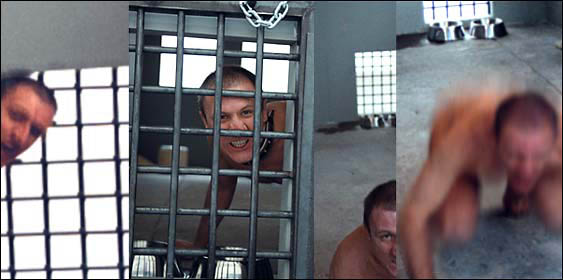
Here's an update to Joseph Beuy's piece by Olek Kulik, which also references the cultural setting of America. "Kulik performed as a dog, this time in a specially built cage, where the spectator would come in wearing protective garb. ... At the Interpol group exhibition in Stockholm in 1996, he performed in the gallery chained next to a sign labelled ‘dangerous’. An international scandal occurred when he not only attacked members of the public who chose to ignore the sign, in one case biting a man, but also attacked other artworks within the exhibition, partially destroying some pieces. For Kulik this was an excusable act, as there was a warning label attached to his performance that people chose to disregard. His intention was to divulge his angst of the current cultural crisis through the violent anger of a dog" [Wikipedia]. Funny piece, though it has the common problem of projecting human emotions onto animals.

Thursday, September 10, 2009

Fetus cookie cutter


Available at www.stupid.com/fun/FETS.html

Donna Haraway's lecture at EGS


EGS video: YouTube

Donna Haraway will be giving a lecture at CCA on 10.20.2009. She wrote "The Cyborg Manifesto", "Promise of Monsters","When Species Meet"... Here's a lecture available online, "Cyborgs, Dogs and Companion Species", about the birth of the kennel, cyborgs, dogs and companion species, humans, machines, computer, organisms, technoscience, genetics, nature, culture, consciousness, philosophy, emergent ontologies, social relationships, societies, Michel Foucault, figure, reference, cyborg manifesto, and socialist feminism, given to the students and faculty of the European Graduate School EGS, Switzerland, in 2000. Partial transcript:

Haraway: It’s a great pleasure to be here, this is something I wanted to do and was not able to do last year so I’m very pleased that Wolfgang renewed the invitation. It’s been a lot of fun. The title of the lecture tonight, in honor of my debt to Michel Foucault, is Birth of the Kennel: Cyborgs, Dogs and Companion Species. It is in light of my debts as a child who grew up with the milk of Darwin, Freud, genetically engineered organisms, and transgenic elements such as plutonium. I read this lecture in terms of my family, my sibling set, the milk of my mothers, Darwin, Foucault and Onco-mouse. This is an inquiry into a term that I’m borrowing from Helen Veron, an Australian philosopher of science, who has recently written quite a wonderful book on African logics and science, particularly on number systems among Aruba-speaking schoolchildren. Helen is using the term "emergent ontologies" in ways I’m finding very fruitful for thinking about technoscience and about the kind of figures around which I organize my work. As a person cursed and blessed with a sacramental consciousness and the indelible mark of having grown up Irish-Catholic in the United States, I’m saddled with a kind of indelible understanding that the sign is the thing in itself. An implosion of sign and substance is part of living with a sacramental consciousness, the literalness of metaphor, the materiality of trope, the tropic quality of materiality, the implosion of semi-auticity and materiality always seemed the case about the world. As opposed to a particularly fancy theoretical insight or mistake, it simply seemed the air we breathe. Figuration is something also inherited out of that same tradition, as taking figures to be those who collect up and reflect back the hopes of a people. Figures are about collective yearning. Figurations somehow collect up and give back the sense of the possibility of fulfillment, the possibility of damnation, or the possibility of a collective inclusion in figures larger than that to which they explicitly refer. I borrowed for many years from Herr Auerbach’s work on mimesis, written of course during the conditions of the war without his library, which is itself a wonderful ironic commentary on the commentary on the history of literature. I always felt very indebted to Auerbach’s conception of mimesis and the turn in Western literature and philosophy whereby the figure and referent somehow become confused with each other in a way which has informed the history of our thought for several hundred years, and the difference of that from classical thought, either of Greek or Hebrew varieties. This has informed my genealogy of cyborgs as well as my post-cyborg entities that I’m calling companion species, otherwise known as dogs, in the vernacular. My genealogy includes this appreciation of figuration that I learned out of both literature and philosophy, as well as this history of growing up as a girl in the American Catholic Church. Now for better and for worse I got known for an article from the early eighties called The Cyborg Manifesto, after the Communist Manifesto. It was a joke, in a way. I was given five pages by the Socialist Review, along with a group of other socialist feminists, to write about what we thought the future of socialist feminism would be in the eighties, after the election of a right-wing president and the growing ascendancy of neo-liberalism, signed by Ronald Reagan and Thatcher and many others. The paper exceeded five pages by quite a bit and was loved by the West Coast Socialist Review collective, and hated by the East Coast Socialist Review collective, who really did not ever want to publish it. It’s had a distressing half-life, the cyborg figure, and has been used to mean almost anything about the join between human and machine, in some kind of deeply ahistorical way that I find maddening, so I want to remind me and us about the historical specificity of the cyborg figure, as well as the material project of the cyborg. Let me begin by a slide that’s particularly about this audience, because I’ve discovered that this audience is particularly savvy in computer-mediated communication practices, a lot of people here do film, video, web design, a lot of people here are involved in various kinds of inventing careers in the margins of and in the centers of various kind of commercial operations, interdigitating with academic work and deep philosophical inquiry, people here are inside the material semi-auticity of informatics, including a strong emphasis in visual culture. The first slide is to remind us of the historical specificity of the cyborg figure.

[Slide shows a monkey sitting in a specially designed space-flight cockpit, inundated with various technological apparatuses]

This creature is named Ham, it’s an acronym for Holoman Aeromedical facility, where Ham, a child captive out of Africa, is raised in the space program, specifically as a "surrogate for man in a race for space." Ham is one of the first advanced primates in space, he is telemetrically implanted and otherwise variously hooked-up and monitored entity. He literalizes the cyborg as the enhanced man-for-space project. That is the project for constructing a co-engineered human machine system based on communication, command and control. Ham is a cyborg figure in a very particular World War II and post-World War II, Cold War space-race configuration. The cyborg is not a figure for just any human-machine moment of connection, it’s not a figure for all of technology all of the time, but for a very particular historical moment. 1960 is the birth moment of the word "cyborg", out of a paper written for a U.S. Air Force aviation medicine conference, in which a psychiatrist and a systems engineer collaborate for arguing the importance of physiological enhancement of man in space, and that the next frontier will be space. The same systems engineer and psychiatrist are the very ones used by Marge Percy in her foundational feminist text, Woman on the Edge of Time, written in the 1970’s, that looks back onto the early cyborg research and its experimental organisms, such as human mental patients as well as the other primates. The first telemetrically implanted cyborg, like all of those who have gone before us in the great exploration narratives, is a rat. A telemetrically implanted rat goes first on the great ships of exploration and will colonize the islands of space just as the European rats colonized the Pacific, much to the detriment of flora and fauna all over the world. Those of you who saw the first rat on Star Trek on Deep Space Nine will know something about the symbolism of the rodent in space narrative. The next slide is a 1988 version of the cyborg, now in the domain of neo-liberalism and the New World Order Incorporated.

[Slide shows an advertisement for Dupont featuring a mouse ascending a staircase]

It’s the world in which better things for better living come to life, the world of DuPont. Some of you have read that this is the figure Onco-mouse, which I regard as a re-telling of the allegory of the cave, moving out to the light out of the depths of the cave, out of the hysteria, that we have a kind of enlightenment figure, a techno-science post-Enlightenment figure, perhaps, again we have a surrogate for a particular figuration of what it means to be human, and we have the convergence of the market and the university, and the medical domain of cancer research. This is one of the products of Nixon’s war on cancer. It’s also one of the harbingers of the future of genetically engineered entities. This organism is the first organism in the world where a major nation-state’s patent trademark office patented not the process by which the organism is produced but the organism itself, so that a very interesting statement is made. The self-moving organism itself is property, but this by itself isn’t new, the history of slavery alone is enough to illustrate that, one needn’t go to other species to see it. I think the patent on this organism signals the sense in which the evolutionary niche, the place of the coming-to-being of species is now the join of the market and university. Patent trademark and copyright law was at the foundation of the U.S. constitution. It’s one of the important subjects that Thomas Jefferson paid attention to, the understanding of the attribution of ownership and authorship. What counts as property and what counts as author is understood to be at the origin of liberty, and at the origin of what counts as a citizen. In some sense these mythic narratives which are also merely mundane facts are stories about civic virtue and civic existence. The cyborg stories are always stories about what counts as civic virtue. The next slide is the feminist artist Lynn Randolph’s version of the story of Onco-mouse, written as the passion of Onco-mouse.

[Slide shows Randolph’s depiction of "The Passion of Onco-mouse"]

She has literally taken the sacrifice of the laboratory animal and produced here a Christ figure, who is a white female rat with breasts and a crown of thorns, in a peep-show, a kind of observation chamber, in a modern neo-liberal air pump chamber like the air-pump of the seventeenth century that figures the material, literary and social technologies that establish matters of fact. Onco-mouse is also a figure of the barely secularized salvation narrative of the barely repressed Christian technoscientific narrative. I argue that certainly in the United States technoscientific narrative makes heavy use of Christian salvation narrative materials.

[Slide shows a ceramic coffee cup emblazoned with the logo for the Washington University Technology Center, of a Native American bird-figure consuming a computer chip and DNA helix]

This is a personal coffee cup, which I’ve made it a point of honor to drink from for a few years. It feels like a kind of a reminder of where I am in the world. We have figured on here one of the major trickster figures of North American cultures, the raven figure, a crucial figure in myth systems all over the North American Pacific temperate rainforest climate areas. The trickster figure figures shape-shifting. The power of the trickster is as an intervener in and disturber of the ordinary. Not a particularly nice figure, the trickster is always a figure of danger, of risk-taking, and of course feeding our trickster figure, our indigenous symbol appropriated for leading-edge technology, that particular constant rip-off for the global universal. That oxymoronic global indigene that raven has become. Its nutrients include an integrated circuit and a double helix, the only thing missing is a dollar sign.

[Slide shows a cartoon of a woman on a cloud contemplating the image of a fetus on a computer screen]

This next slide comes out of a Swedish feminist magazine, I call it "the Creation of Adam", and of course so did Michaelanglo, we have a whole series of reversals in this ectopic pregnancy that goes off-screen, literally. We have the female Adam, specifically not Eve reaching her finger to the interface with God, the computer and the keyboard, is the figure of God the fetus, or is that the Eve, that God is embracing, is that God or what? The one thing we know about that fetus is that its fate is not to be born, at best to be downloaded, it’s very likely she"s aiming for the delete key, or perhaps simply editing the file, or any number of operations which certainly do not include birth. The relationship of that fetus to that female body is highly problematic, but we know we are at some moment of touch, from this today forward I hereby predict that you will not move a day through technoscience, that chronotrope in which we now live, without seeing some iconic reproduction of Michaelanglo’s touch of God with Adam. It is everywhere in contemporary technoscientific iconography. There is a small set of images, from Da Vinci, Michaelanglo, and so on, used to figure "genius, science, and me", elements that are used in the remarkable arrogance of technoscientific advertising. Now I’ve just shown you a series of slides I’m not talking about. The slides that you’ve seen up till now fit the cyborg paradigm rather well, in terms of the lineage of offspring from that 1960s moment. The next few slides sort of fit it, but we’re moving into the kennel, and I’m going to be moving us away from cyborg figuration and now I’m into companion species figuration. I want to start it at the cyborg end of things.

[Slide shows an advertisement featuring a terrier wearing an electronic monitor collar]

This is a lovely little Yorkshire terrier, it’s modeling the latest in reproductive technology for the kennel, which is marketed to monitor the pregnancy of a particular kind of dog whose head is too large to permit a so-called natural birth through the birth canal. If the puppies are born through the uterine canal, they will break their necks. There is an obligatory cesarean section for this particular breed of dog, whose recent evolutionary history has regarded selection for traits that don’t permit non-technologically mediated birthing. Now it’s possible to tell the evolution of the dog story in terms of dog-initiated use of human-provided resources, co-extensive with a history of the human species. Dog-wannabe wolves making use of human garbage, human wastes, dumps of various kinds, selecting themselves for shorter and shorter tolerance distances to human encampments, these kinds of stories are widely told these days about evolution of so-called domesticated dogs. Reversing the order of invention, humans didn’t invent dogs, dogs invented themselves and adopted humans as part of their reproductive strategy. The way of telling the technology story is not that technology invades nature once again, but that dogs have scored another coup, and now have appropriated high reproductive technology for their own reproductive strategy. That is of course a generous reading of this device here, which is actually a practice that offends me on many levels. It does permit more than one reading, which is one of the lessons I want to leave with this.

[Slide shows an advertisement for a camera device intended to be used by dog breeders to monitor their animals]
read more
Friday, August 28, 2009

Meatrix trilogy


Videos: www.themeatrix.com

A hilarious parallel to the Matrix trilogy, Meatrix is created by Sustainable Table and Free Range Studios. Not sure about the shoot-out part... Do the authors condone violent revolution? Yes, the Matrix employs violence but it's a Hollywood flick meant to entertain, not art meant to provoke questions about assumptions, a deeper examination of issues, or a serious critique.

Thursday, August 27, 2009

King Rat directed by Heath Ledger


Image: Still from King Rat music video

Heath Ledger collaborated with Modest Mouse on King Rat, an animated music video depicting a world where humans get harpooned by whales. The video, produced by The Masses and released in August 2009, is now available at iTunes. The video can also be viewed online at the masses, myspace, offUhuge... Even though the ending could be improved (the video was finished after Ledger's death) and the title is othering, this video is often surprising.

Tuesday, June 16, 2009

'No shark-fin' cards

I've been looking for a card to hand to restaurants and found some on Humane Society's page. If designing the card from scratch, I would take out the pledge part (more suitable for Western-style communication) and use one of Rob Stewart's gorgeous shark photos.

For weddings I found this card to explain to the older generation, via browsing a Singapore wedding site where someone posted: i just went to a buffet style wedding and half the people there boycotted the shark fin soup (myself included) so it was even more wasted loh. This postcard is from WildAid. If you need a stack of them email WildAid (Victor Wu, wu@wildaid.org, or whoever is handling it at this time).


If parents object, maybe explain that sharks have the most mercury, since they're top of the food chain and toxins accumulate in their system as they eat other animals. Mercury (from our pollution of oceans) is a neural toxin that damages the brain and nervous system and can cause sterility in men. People who eat seafood regularly already consume too much mercury <www.chinadaily.com.cn/english/doc/2005-05/21/content_444520.htm>. People who're for not eating shark-fin include Yao Ming, Lisa Ling, Ang Lee, Jackie Chan (video PSA's at WildAid), and other people endorsing WildAid are Zhang ZiYi, Jackie Chan, Maggie Cheung, Chow Yuen Fatt, Michelle Yeoh, Joan Chen, Tony Leung, and more. Soup alternatives at these wedding sites in Singapore and Malaysia.

This couple who made their own elegant card for their wedding also has a page to explain it. And yes, you can order their cards or download them.


Background
Each year almost 100 million sharks are killed to make shark's fin soup. Many times a shark is dragged onto a boat and its fins cut off, then tossed back into the ocean while it dies a slow and painful death. This practice is not only cruel but wasteful. (www.sharkwater.com)

Many species of sharks that are caught are friendly. Deborah Peterson wrote, "In testament to how friendly some sharks may be to human advance, yours truly actually braved the shallow waters to hug a shark once ... What I found most surprising was the texture of the shark's skin which was rough to the touch, with a very firm body -- not fat, blubbery or slippery as I had imagined. The shark seemed to take my advance to pick it up without a hint of struggle or fear of humankind, in a sense, showing a trust" (photo of Deborah hugging shark at www.lifeinthefastlane.ca). Photos of a hammerhead shark that's finned below (from www.protect-the-sharks.org).


Many sharks are facing extinction
including the hammerhead shark pictured above. Below is a photo of Rob Stewart swimming with reef sharks (www.sharkwater.com).


Here're some cartoons by Mutts:


www.hsus.org/hsi/oceans/sharks/shark_finning/mutts/

Wednesday, May 13, 2009

about post(human-animal)

'Human-animal' is a term used by theorists such as Carol J. Adams instead of 'human' to counter the anthropocentric concept of the (non human-animal)/(human-animal) boundary. Here 'post' is used, as in posthumanist criticism, to refer to an understanding of the world through context and heterogeneous perspectives.